Veticure
A mobile application that enables pet owners to access reliable pet health knowledge easily.
↓ View More
Overview
A team project aimed at providing dependable advice on pet health when pet owners are unable to distinguish between changes in their pets' behavior and potential health issues.
Duration
Feb - May 2022 (4 months)
Team
1 UX Researcher
My Role
UX Designer
Facilitating and moderating interview sessions
Analyzing and prioritizing research findings
Generating wireframes for concept testing
Iterating based on user testing
Developing color schemes and UI kits
Designing high-fidelity prototypes
Pet owners use unverified online resources when having concerns about their pets
The Problem
As a animal lover, I've noticed that people are often concerned about their pets' health and view them as family members.
Some pet owners believe in folk remedies and follow unsubstantiated rumors on the Internet when they have small concerns about their pets. These practices unintentionally put their pets at risk because good known explanations are being ignored.
Image by pch.vector on Freepik"How might we help pet owners reach the correct treatment when their pets exhibit signs of health problems?"
The Solution
Veticure
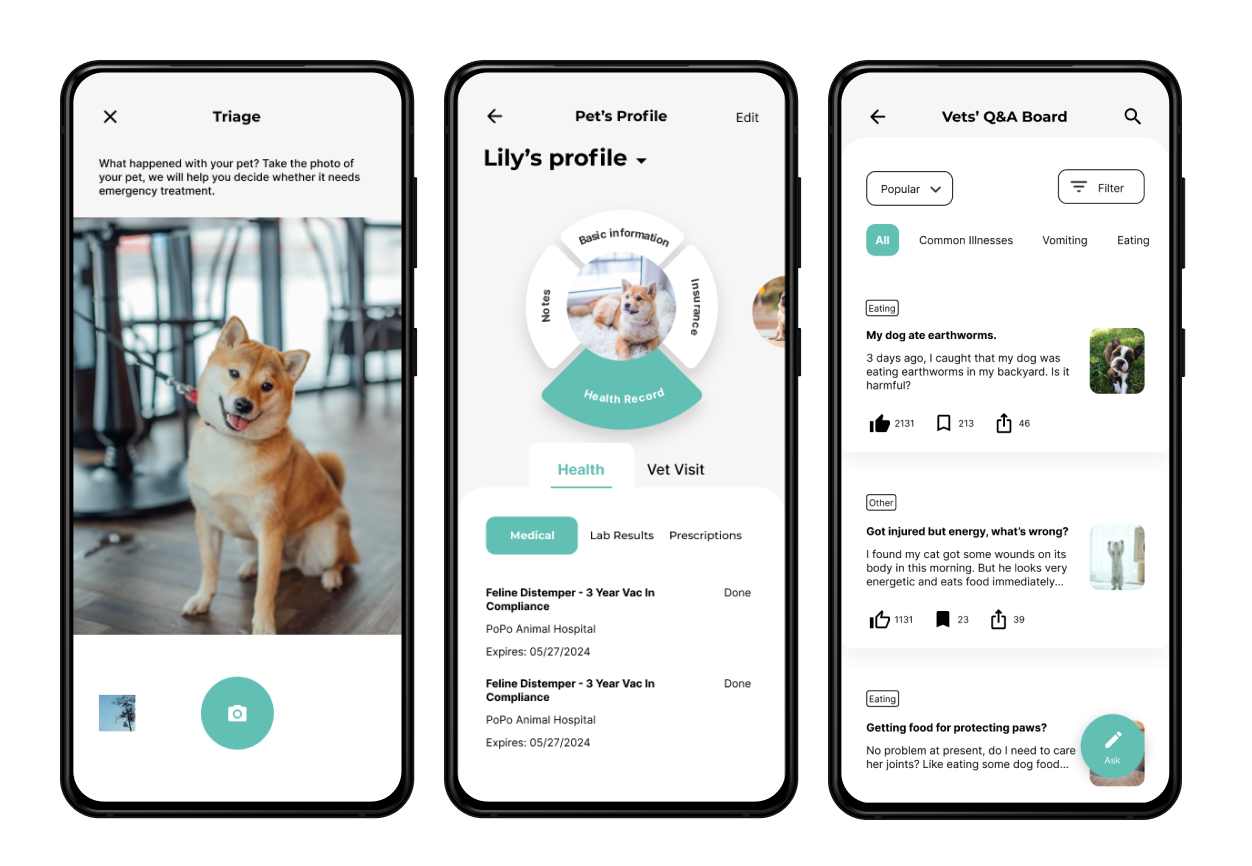
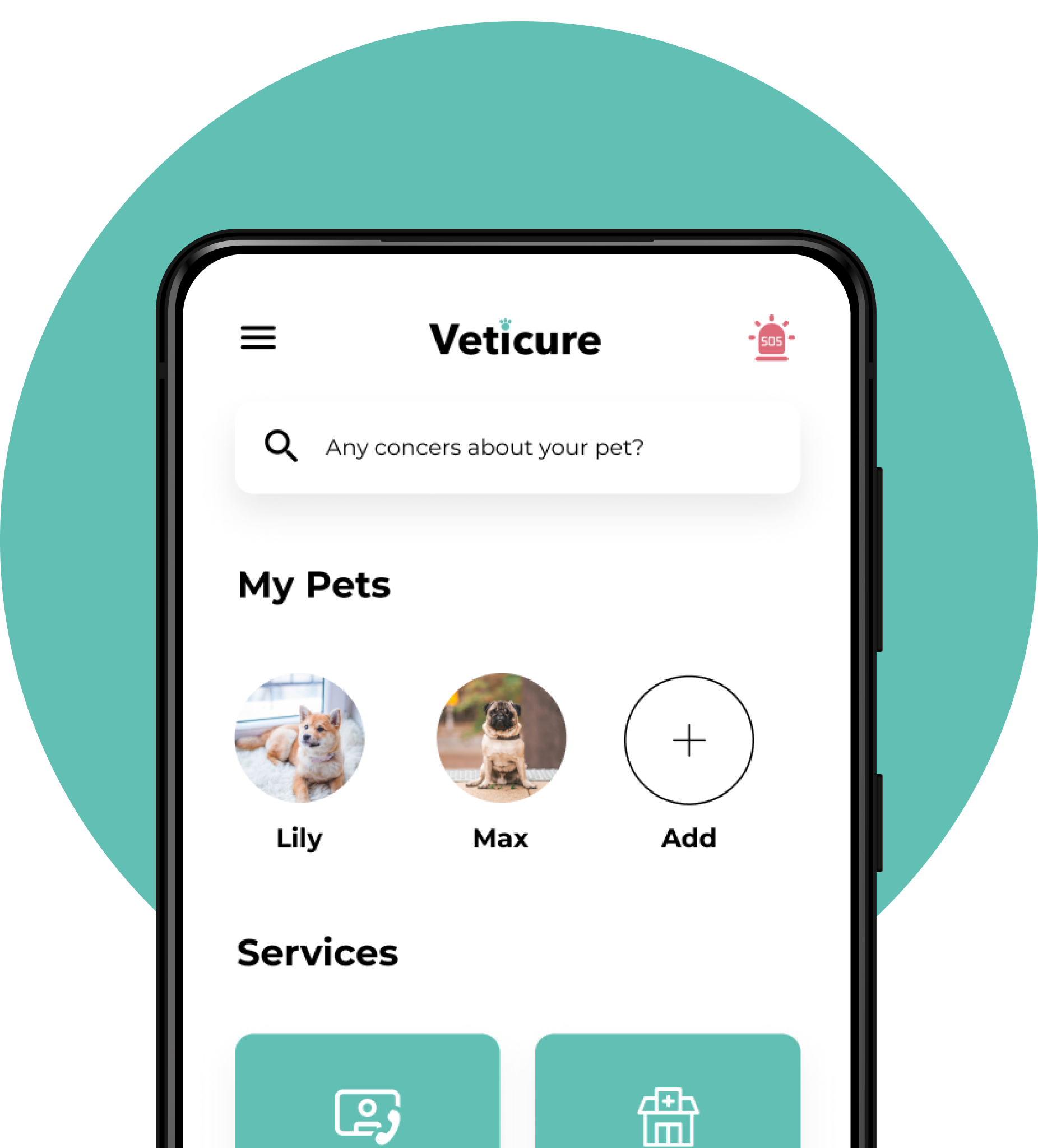
Veticure is an app for pet owners to get reliable advice about their pets. Users can take pictures of their pets and get advice on accessing trustworthy resources and vet consultation services. This helps pet parents avoid unverified suggestions and timely interventions.
Key features
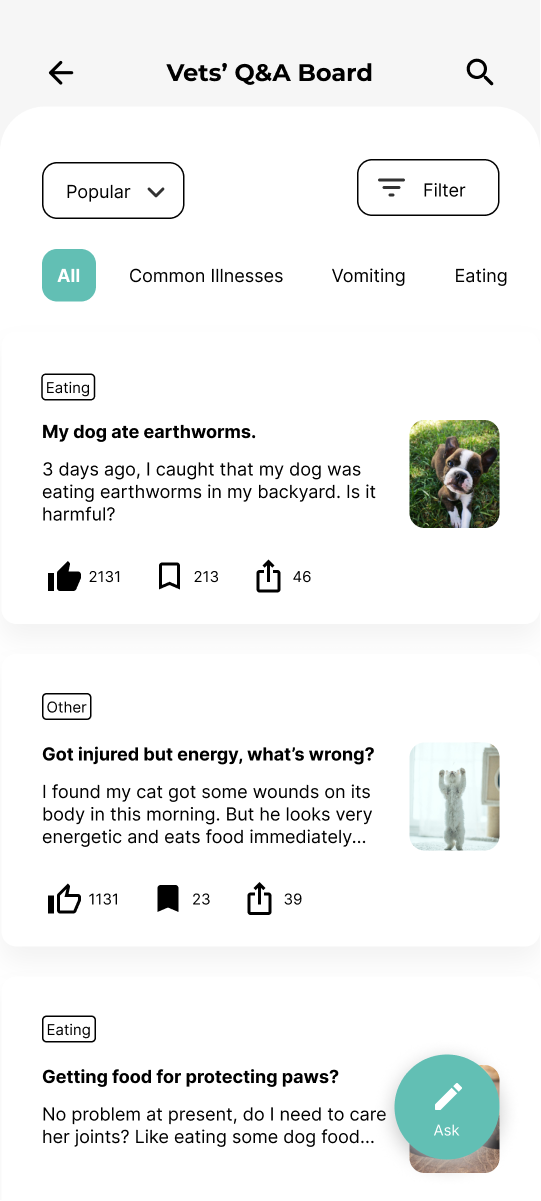
Post a question on the vets’ Q&A board
Pet owners can post their non-emergent questions for vets to answer or refer to vets' advice regarding similar situations that other pets encountered before.
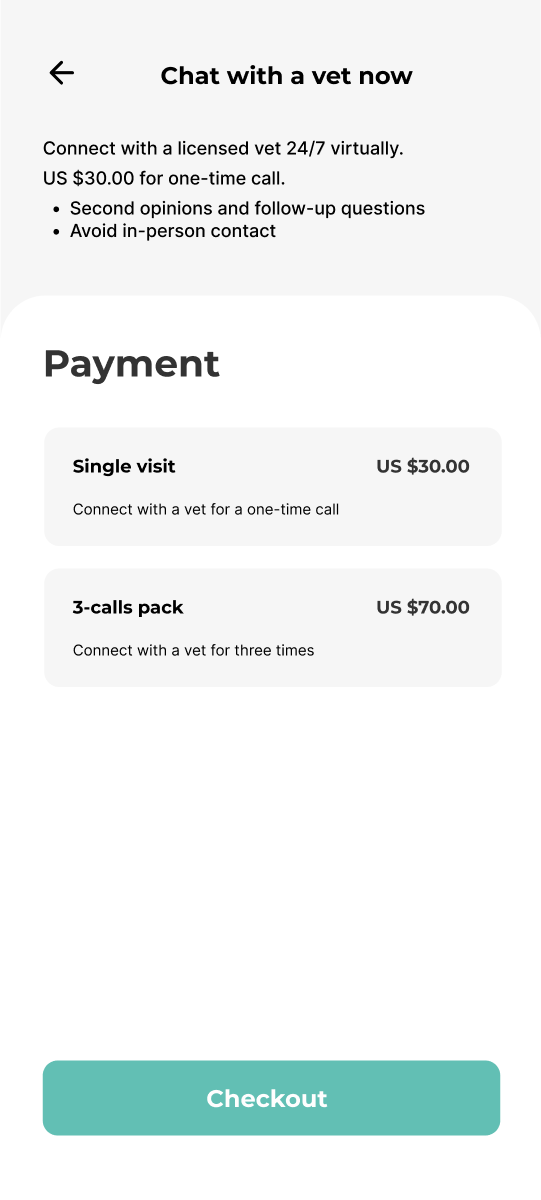
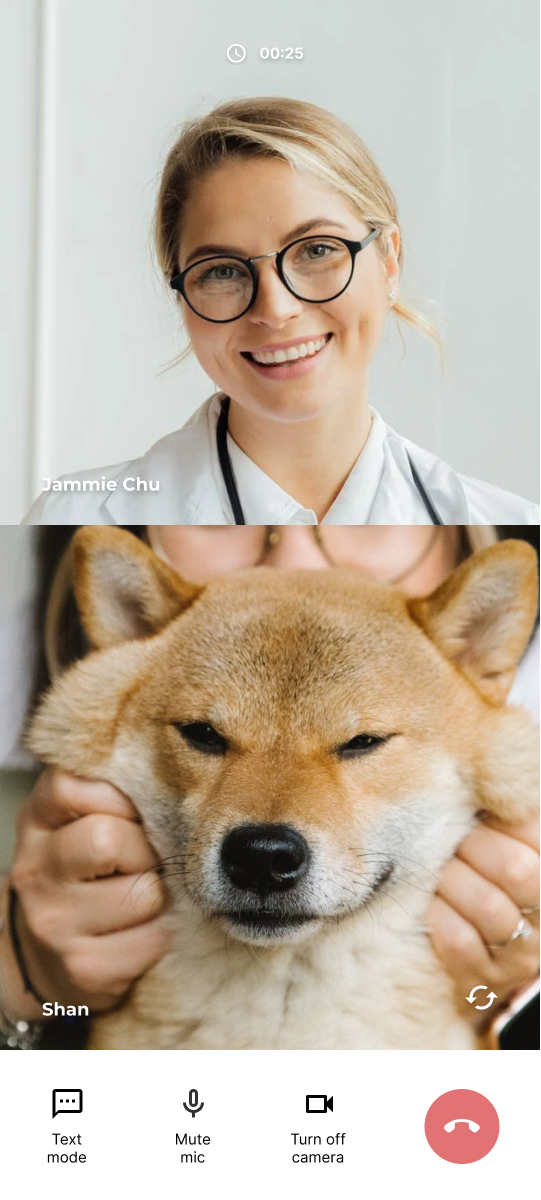
Chat with a vet now
Pet owners can speak with a vet anytime instead of going all the way to the clinic or finding vets late at night.
Gauge the situation with the triage camera
Pet owners can identify how emergent the situation is and triage it with an AI camera, such as seeing vets in person/ virtually, or browsing the same situation on the Q&A board.
Link records to the pet profile
To better remember the pet’s chronic health problem(s) and advice from vets’, the health records and documents are also connected to the pet profile.
Discovery and User Research
Our survey showed that the main groups of pet owners (Gen Z, Gen Y, and Millennials) think they only need a vet during emergencies.
For non-emergency situations, they prefer to search for information online as it is faster and cheaper.
Online Survey
35 participants: Millennials, Gen Y, Gen Z
I search for info online when having a concern about my pet’s non-emergent health situation.

77%
I am willing to get immediate pet advice.

89%
User Interview
Interviewees are eager to resolve their concerns by getting reliable advice from vets immediately.
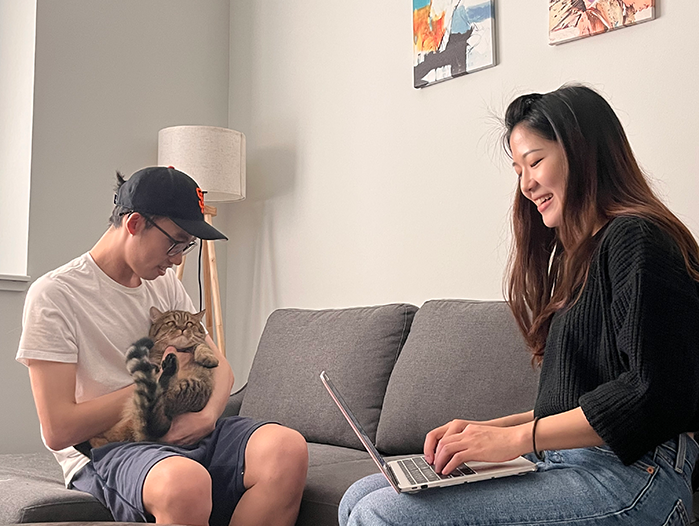
We interviewed 6 U.S. pet owners to learn about what affects their decisions on where to seek help for their pets. Our findings revealed that the main issues with searching for vets are that they are not available 24/7, expensive, and take up a lot of time.
Key Insights
We sorted survey and interview findings into themes using affinity mapping, then prioritized the most important issues and users with a 2x2 matrix. Based on this process, we focused on three key insights.

Availability of Vets
Users are required to get treatment or at least receive answers to their questions immediately.

Triage by different conditions
In emergent conditions, because of panic and lack of professional knowledge, users have a hard time deciding what action to take.

Track and document
Users want to keep their pets' health documentation and records to enable vets to provide specific advice to their pets.
Competitive analysis
Opportunity:
Triage feature
We conducted a competitor analysis on pet and human health tools to understand the competitive landscape. However, we discovered that none of these tools had a triage feature to assist pet owners in selecting the appropriate treatment.
Ideation and Design
Wireframing
Since our users often used their mobile phones to capture their pets' behavior and to look up information during emergencies, our team decided to focus on a mobile solution.
We generated many ideas for solutions through sketches and combined similar ones to create flowcharts and high-fidelity wireframes. These were then tested with our users.
Testing
Concept Testing & Iterations
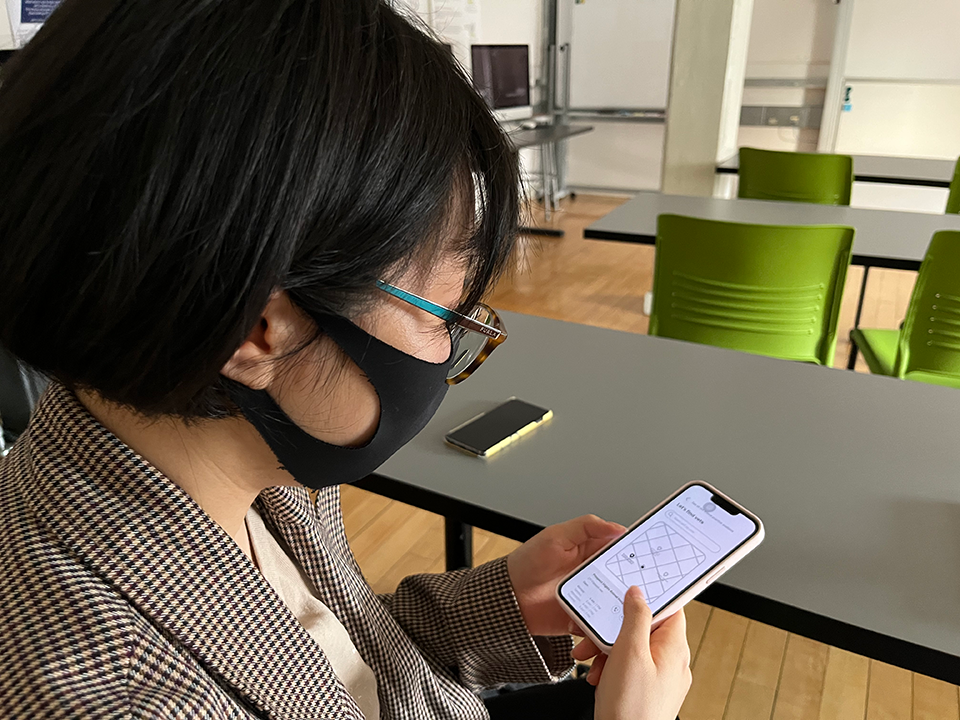
We received feedback from 5 pet owners on our low-fidelity prototype to improve our product's architecture and key flow. We made changes and iterations to the homepage, Q&A board, local practices, and triage page based on their feedback.
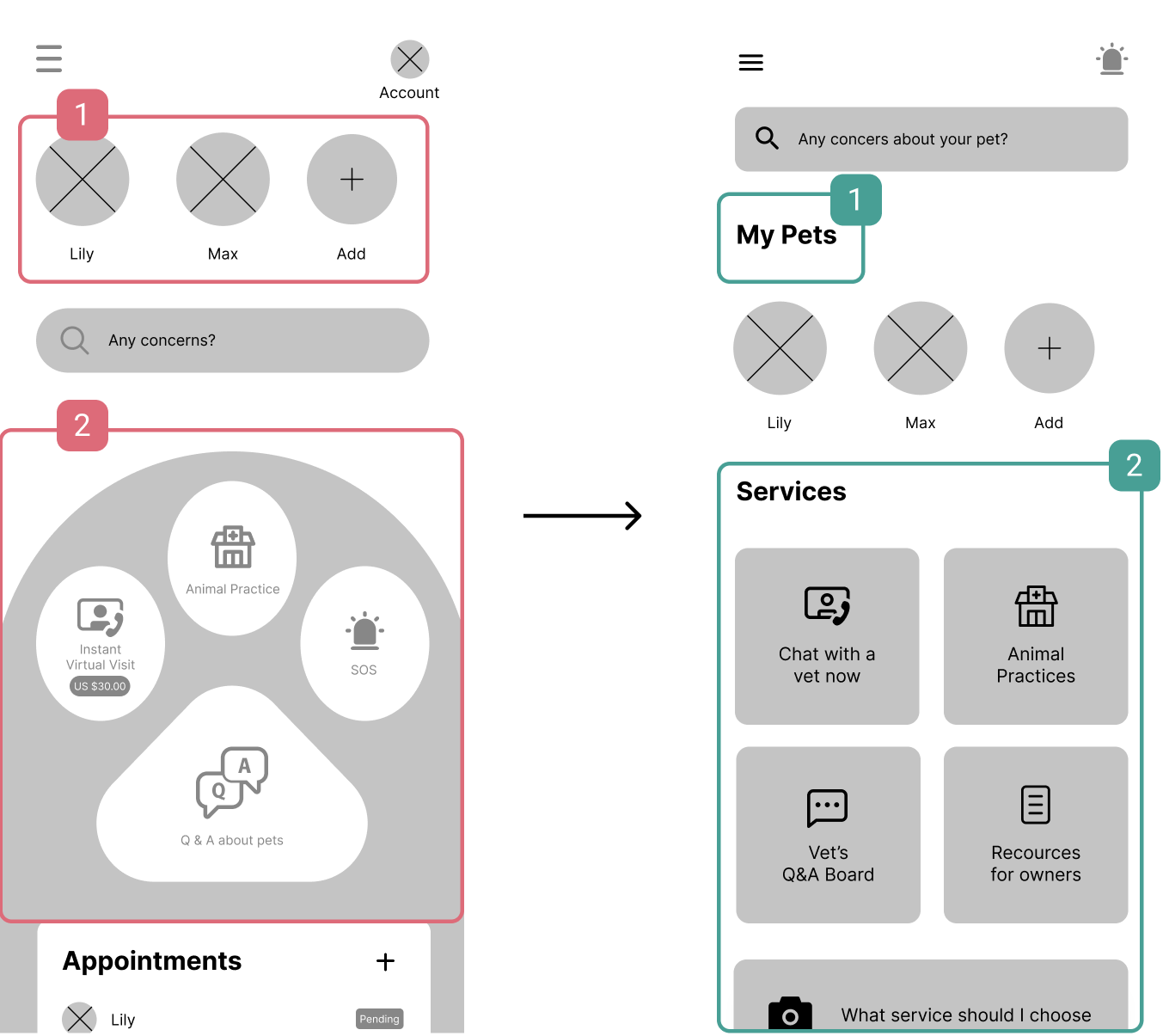
BeforeAfterClear Navigation
Header:
The display of the pet photograph profile is working, but without text that explains the photo as part of a profile, it is still confusing.Button layout:
We changed the layout of the services to four equally sized squares to improve readability, as testers found the previous paw-shaped layout to be cute but difficult to read.
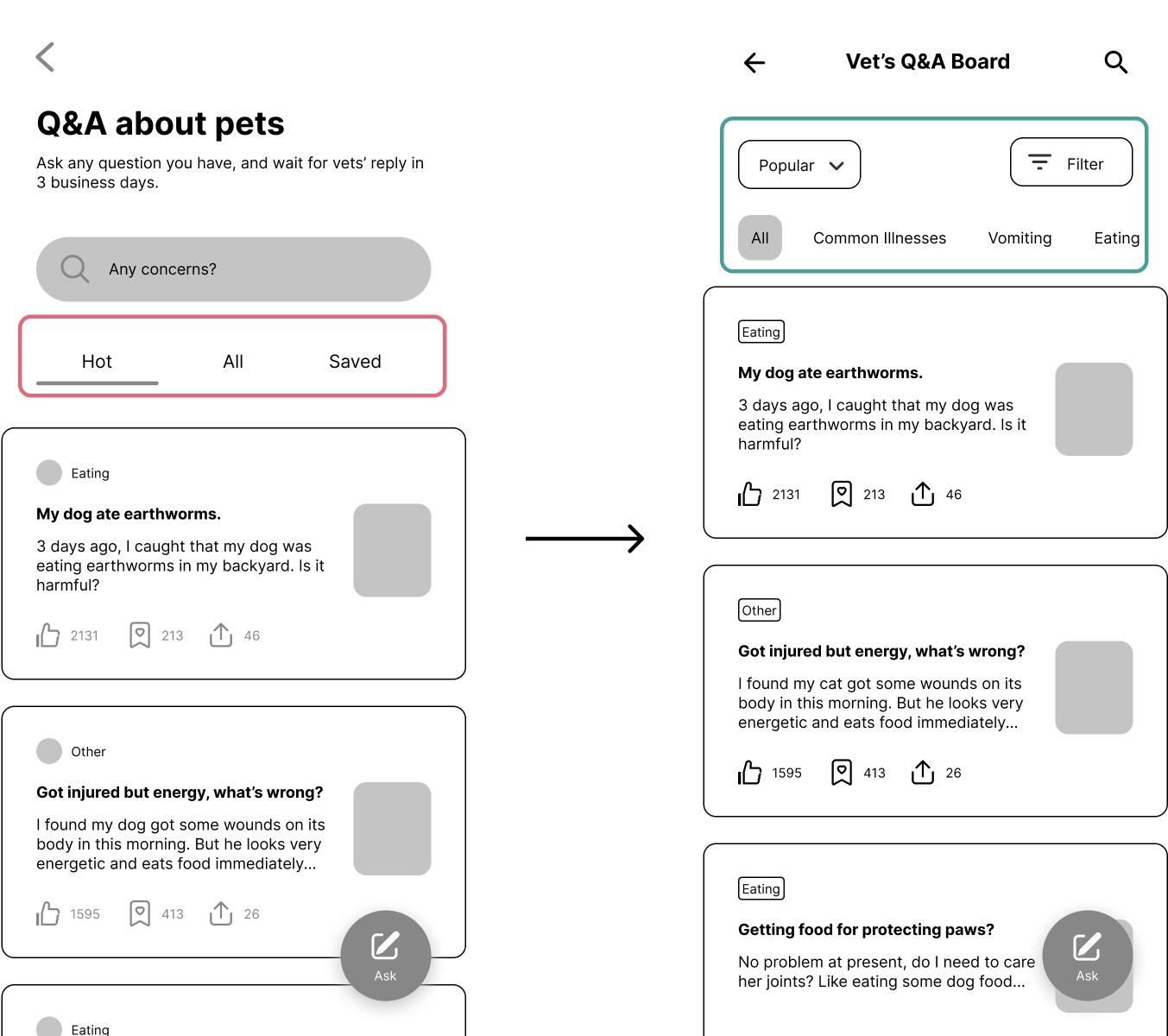
BeforeAfterFilter Category
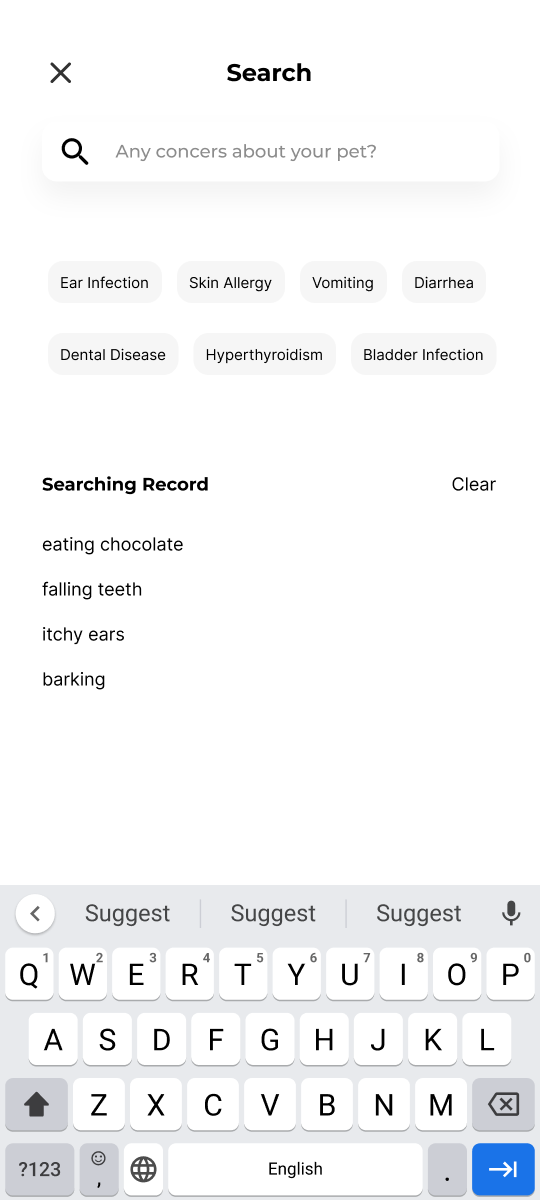
Testers complained that they sometimes just want to browse other pet owners' issues rather than have a specific question. We created various health categories which include the topic of common illnesses.
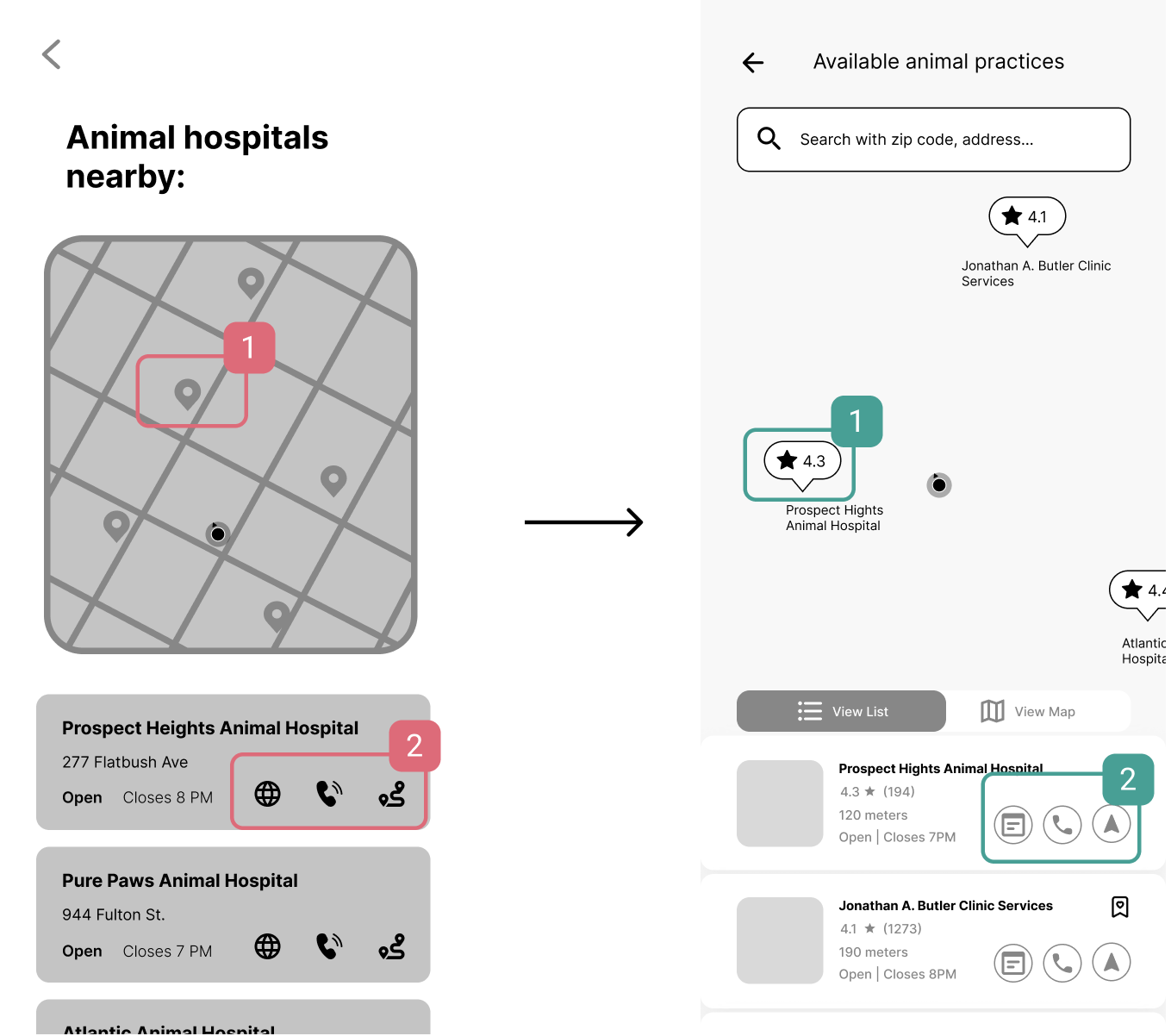
AfterBeforeSearch with ease
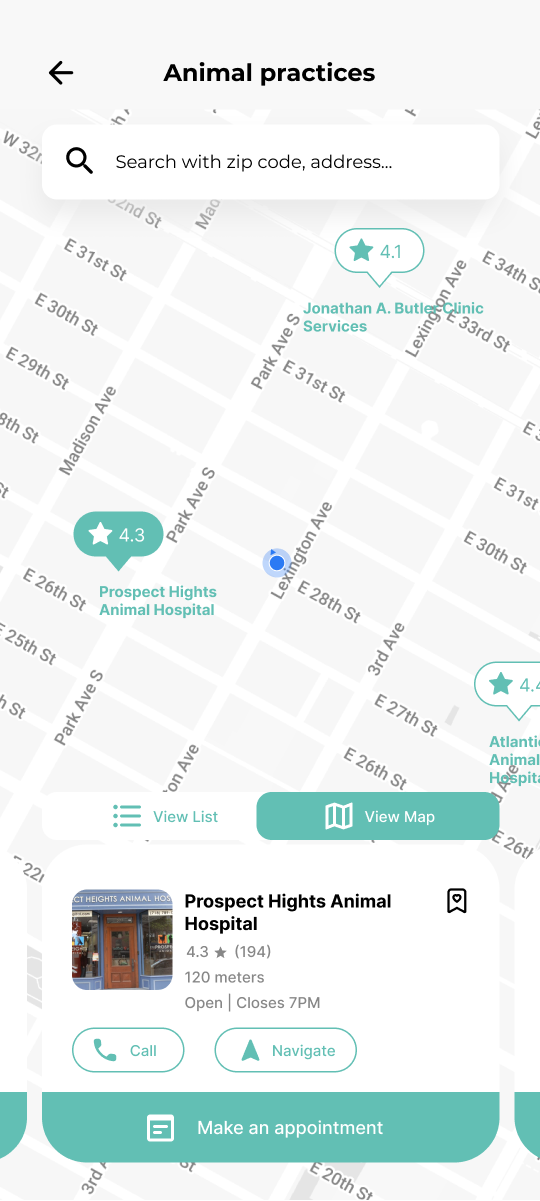
Rating first:
We added user reviews and ratings on a full-size map for easy access, as these factors are important to pet owners.Understandable icons:
We used Android Material Design icons to ensure consistency and improve the clarity of icons for all users.
BeforeAfterFast Triage
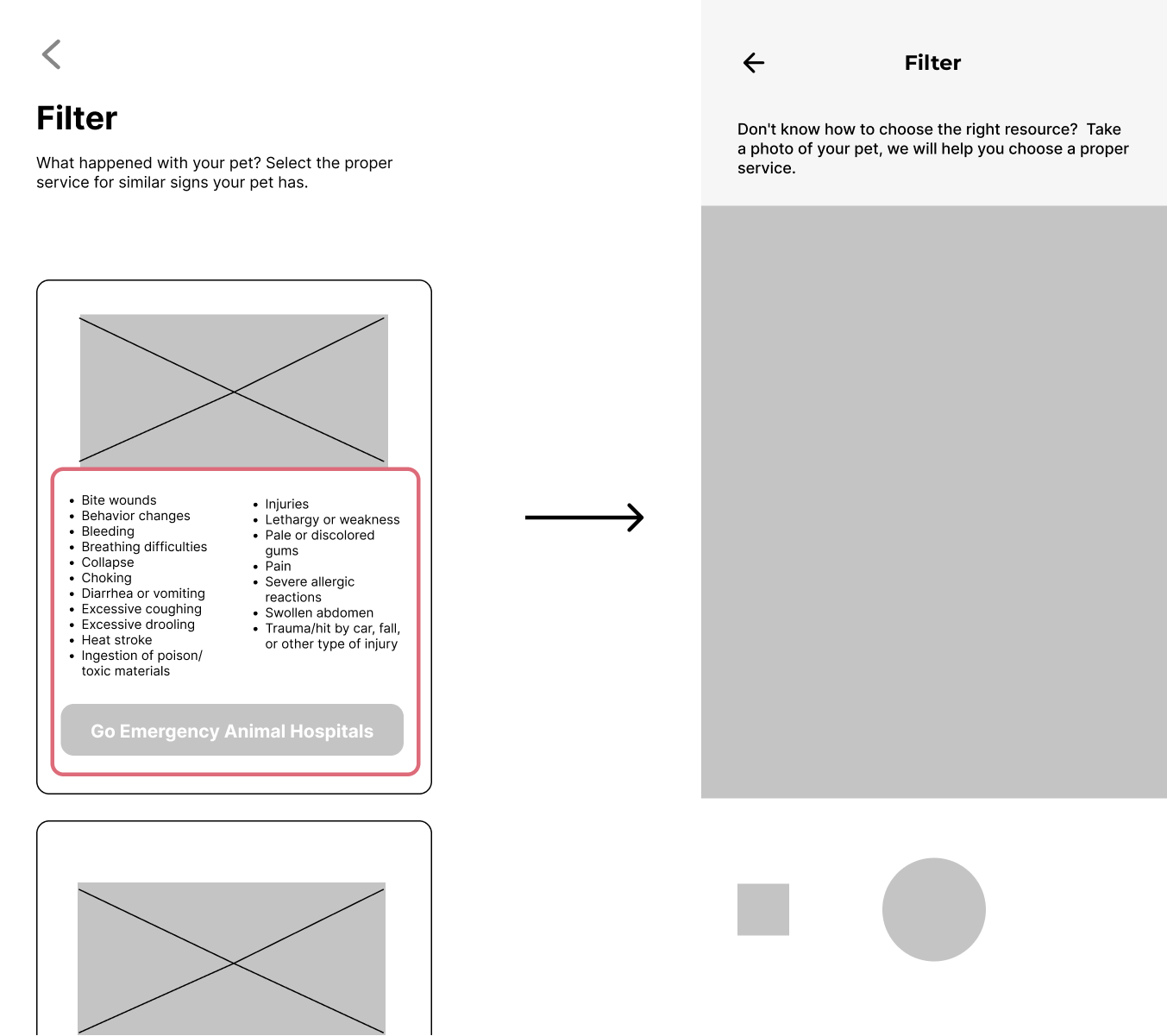
We found that some users had trouble finding the emergency button due to crowded text on the page. To make it easier, we added an AI camera feature that can quickly identify if emergency treatment is needed.
Design
Design System
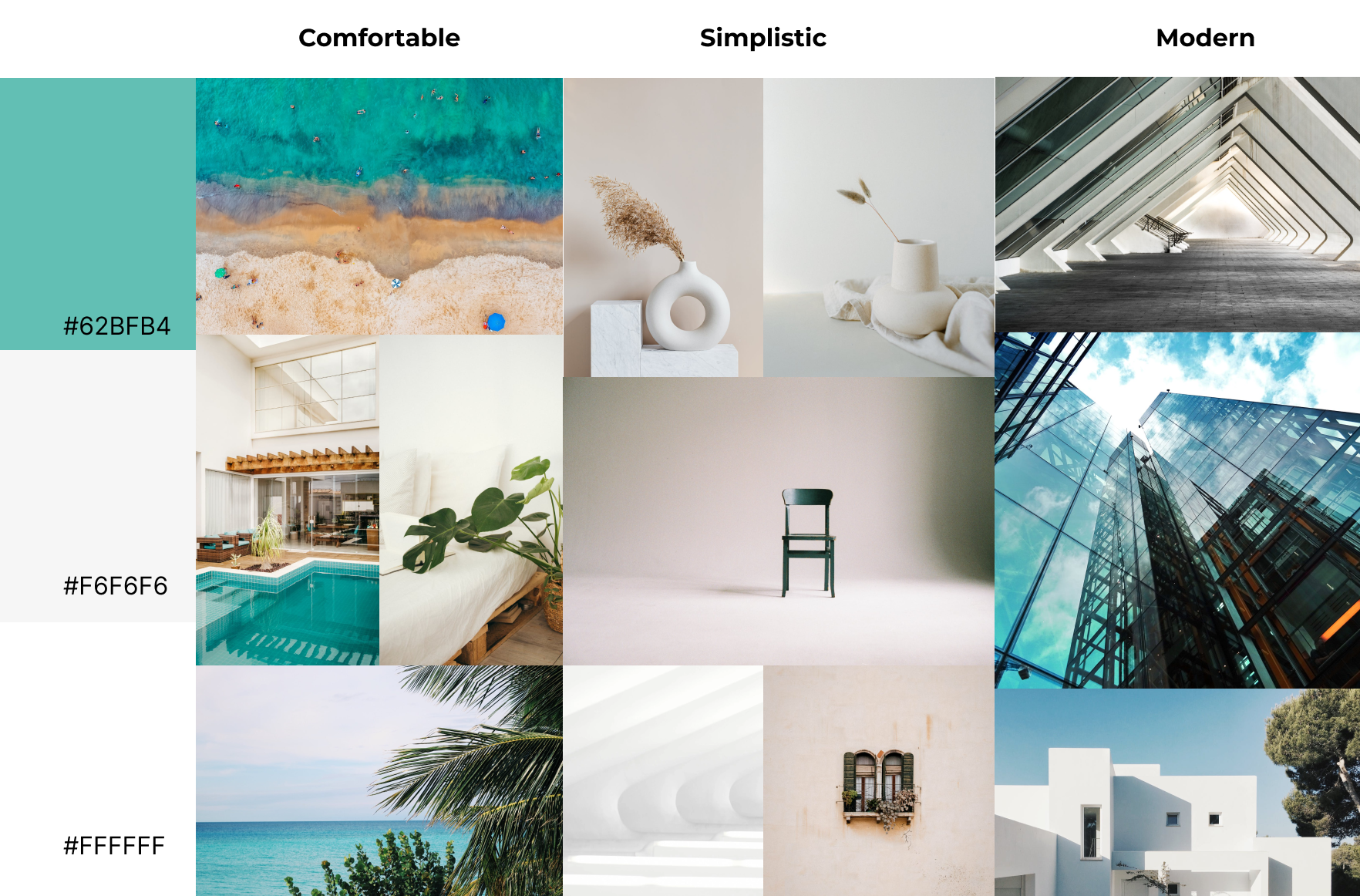
To reflect the key attributes of our app - Comfortable, Simplistic, and Modern - we created a mood board and derived a color palette.
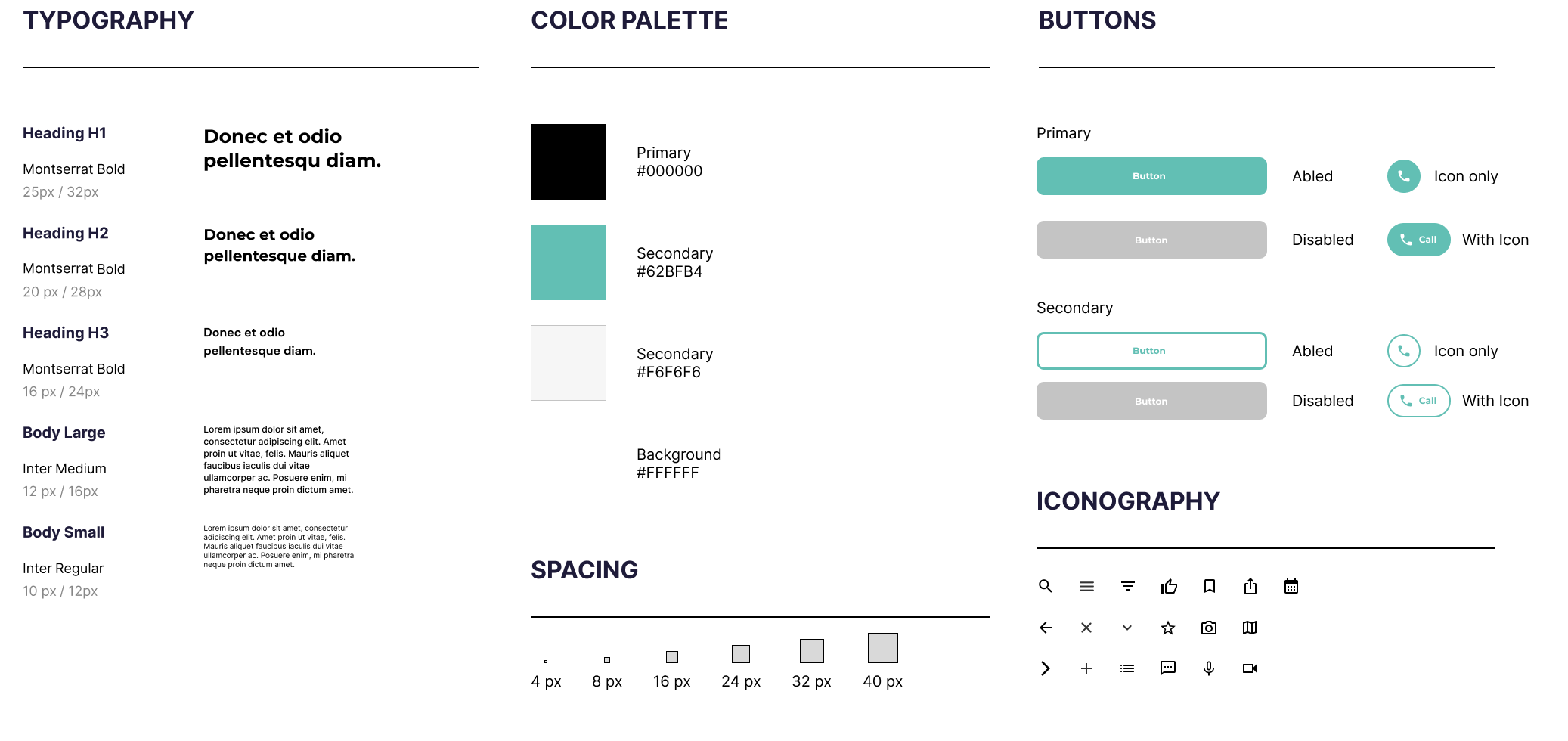
As the UI lead, I defined the design system and developed the prototype by selecting typography, buttons with a 10px radius, and other components that align with our playful and relaxed style.
Design
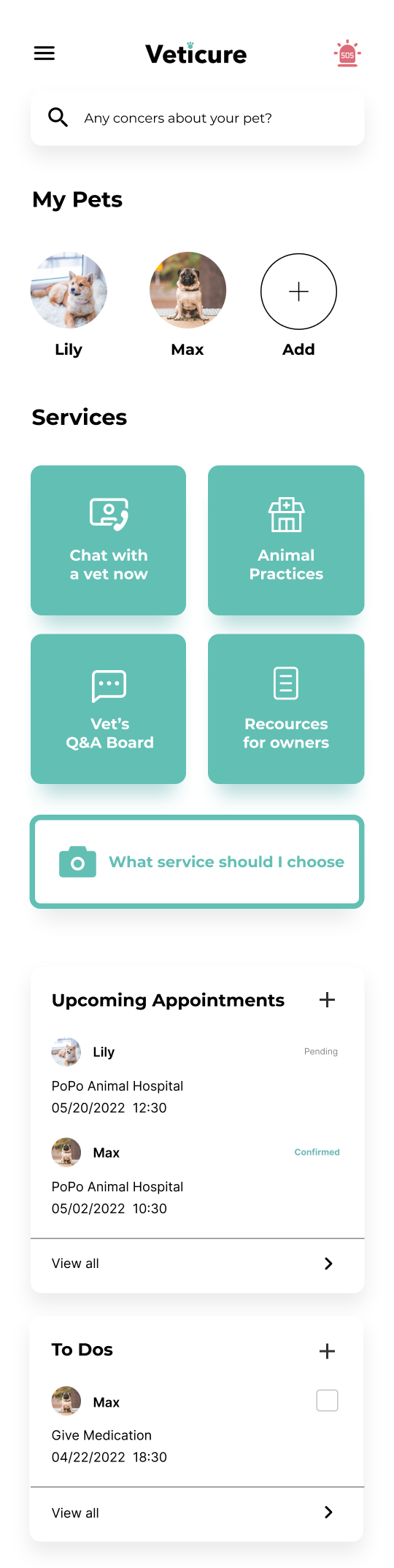
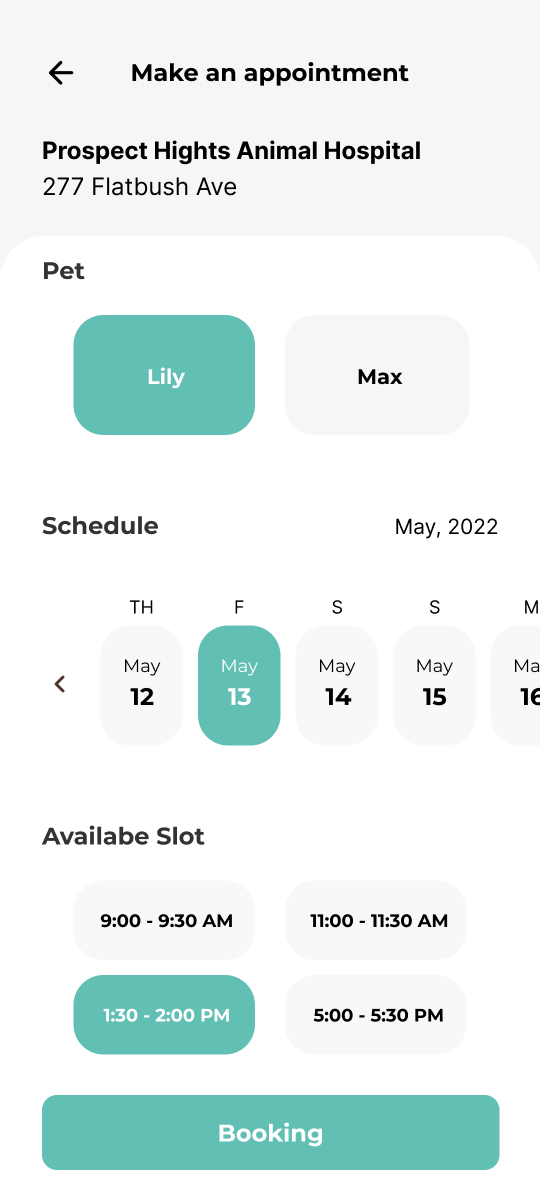
Hi-Fi Key Screens
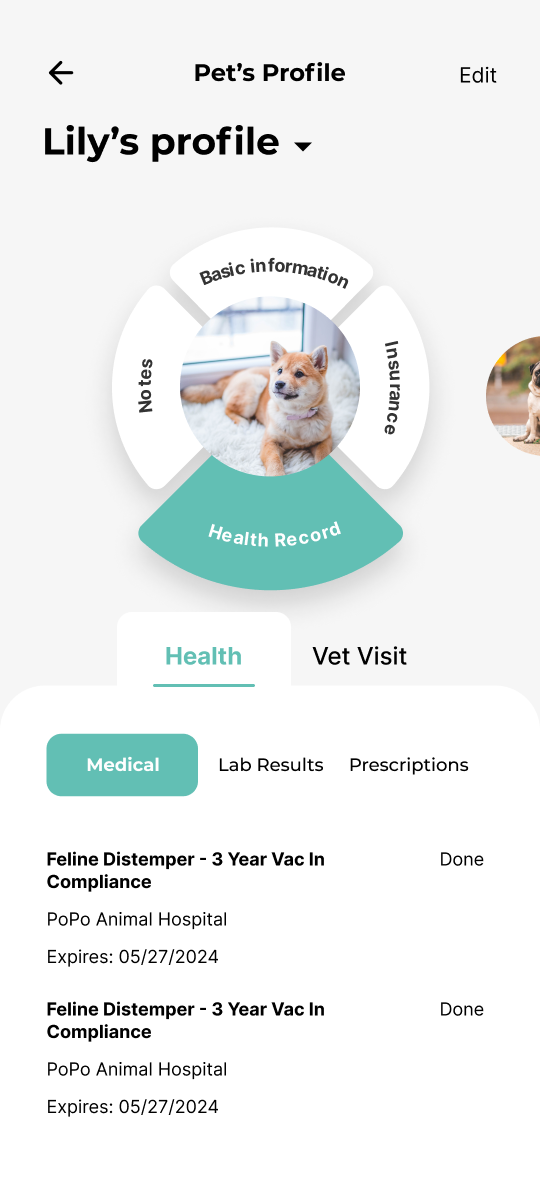
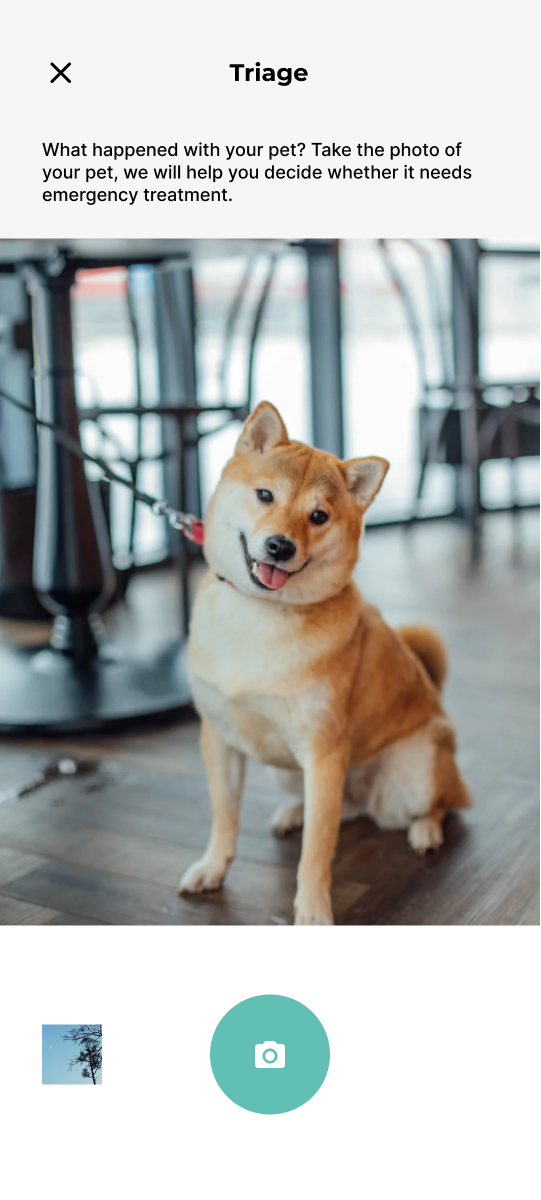
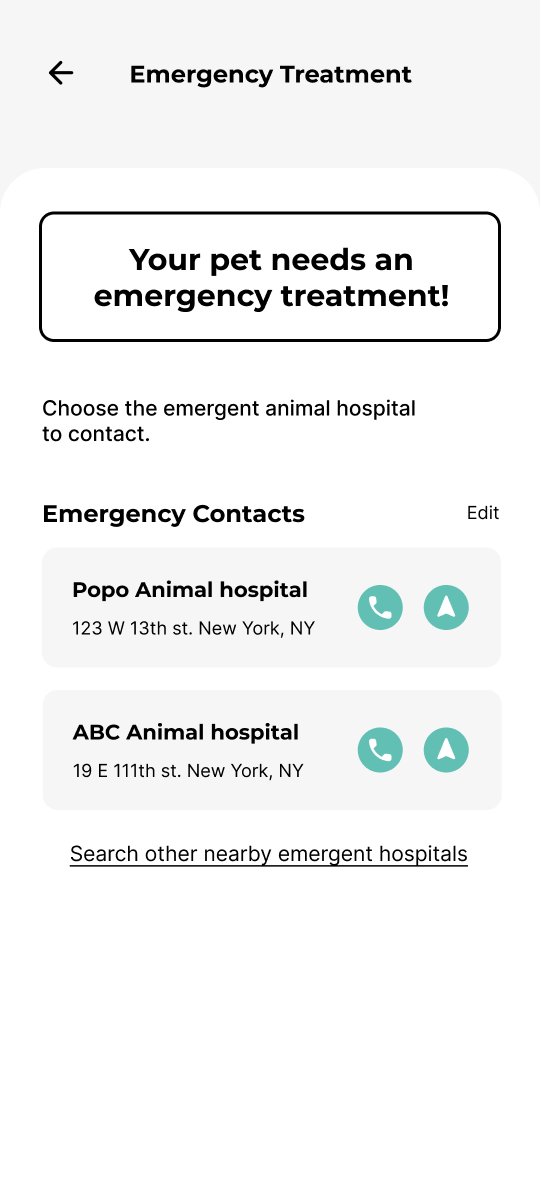
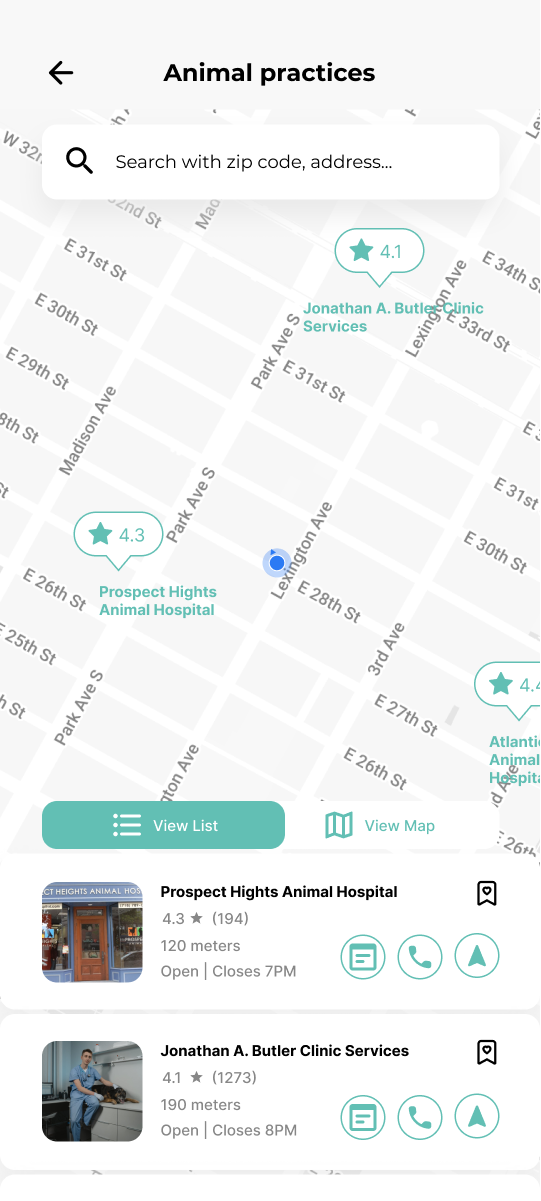
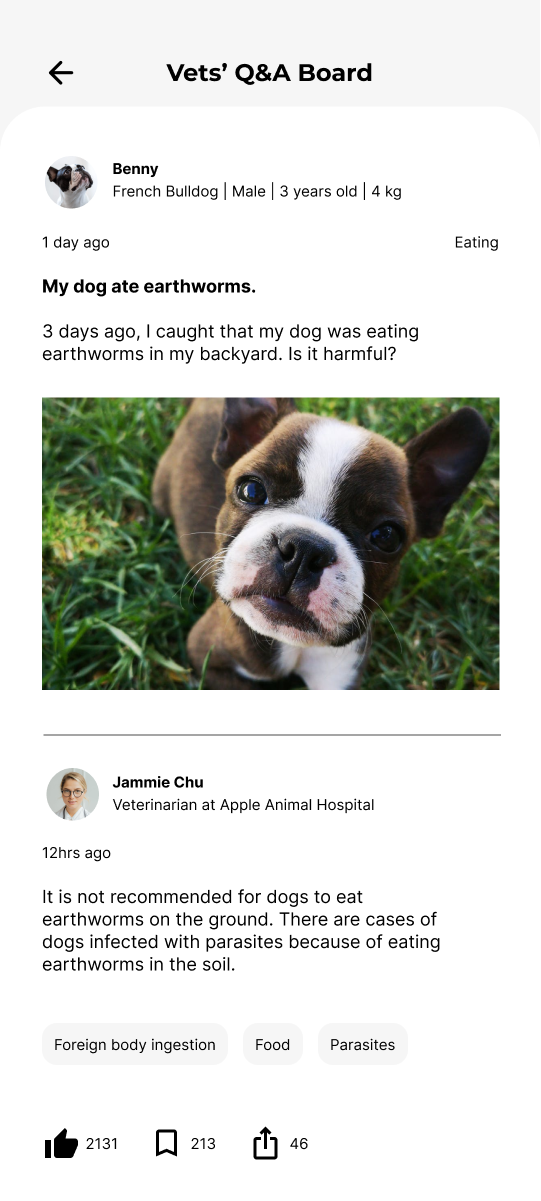
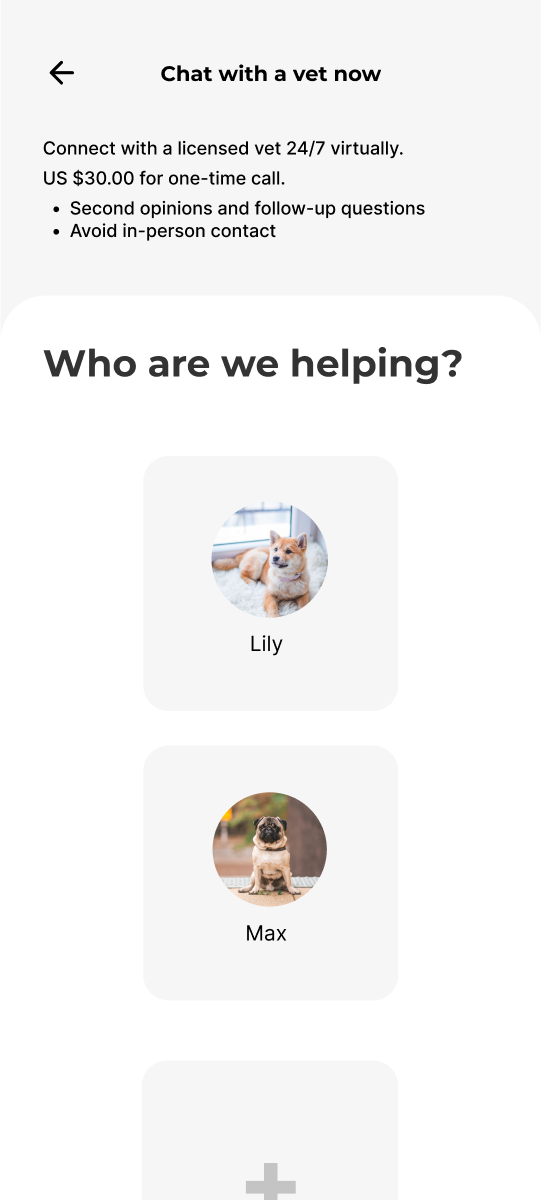
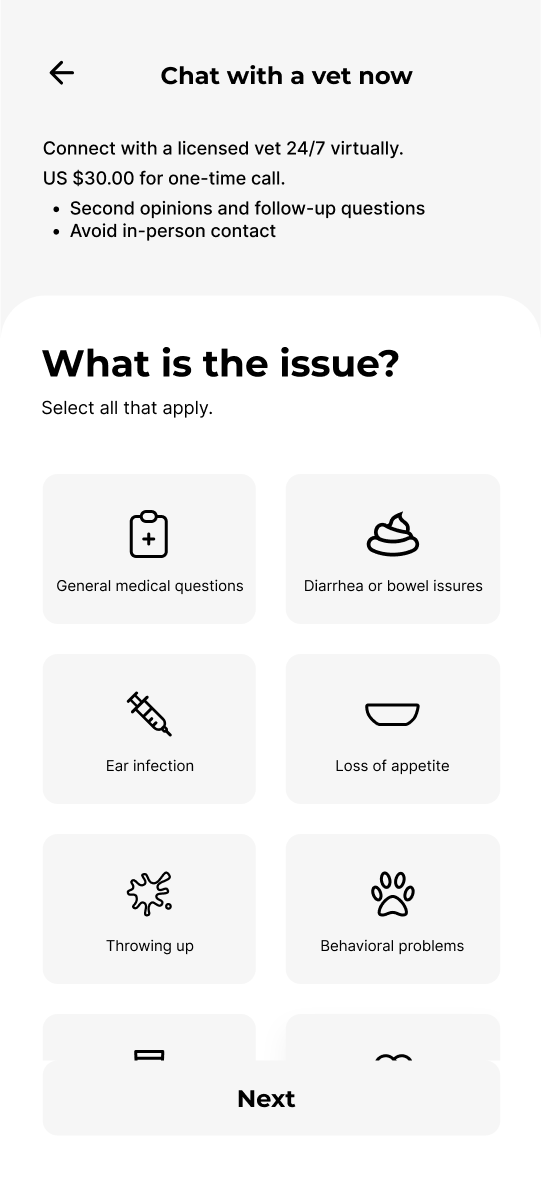
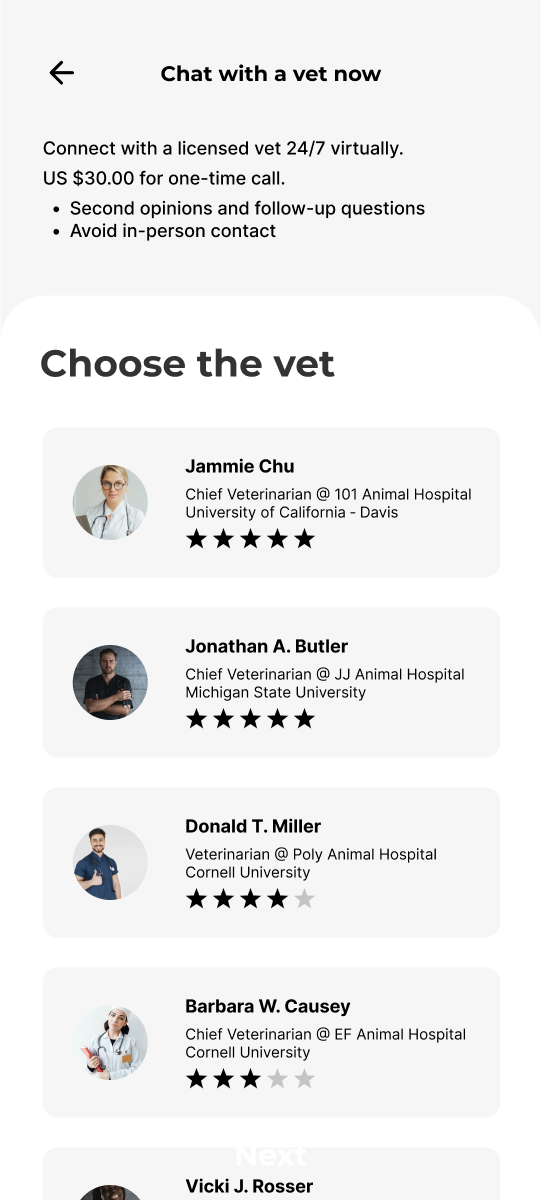
Reflection
What I learned
Diverse perspectives lead to new insights.
Collaboration is common in UX design. Diverse perspectives helped us learn new insights and better understand users. It also improved our problem-solving and communication skills, leading to better design solutions and a more enjoyable user experience.
Don't get distracted by feedback that is out of scope.
Not all feedback is relevant or useful for a specific design challenge. I found that some users want more features than are possible, but incorporating all feedback would distract from the product's focus.
You may also like
-
![]()
Nearby Parking
A two-sided marketplace that connects people who want to rent out their idle parking spots with people who are looking for places to park.
-
![]()
EmoBeat
A wearable solution that utilizes biometric data and emotion to address the problem of song recommendations not matching young adults' preferences
-
![]()
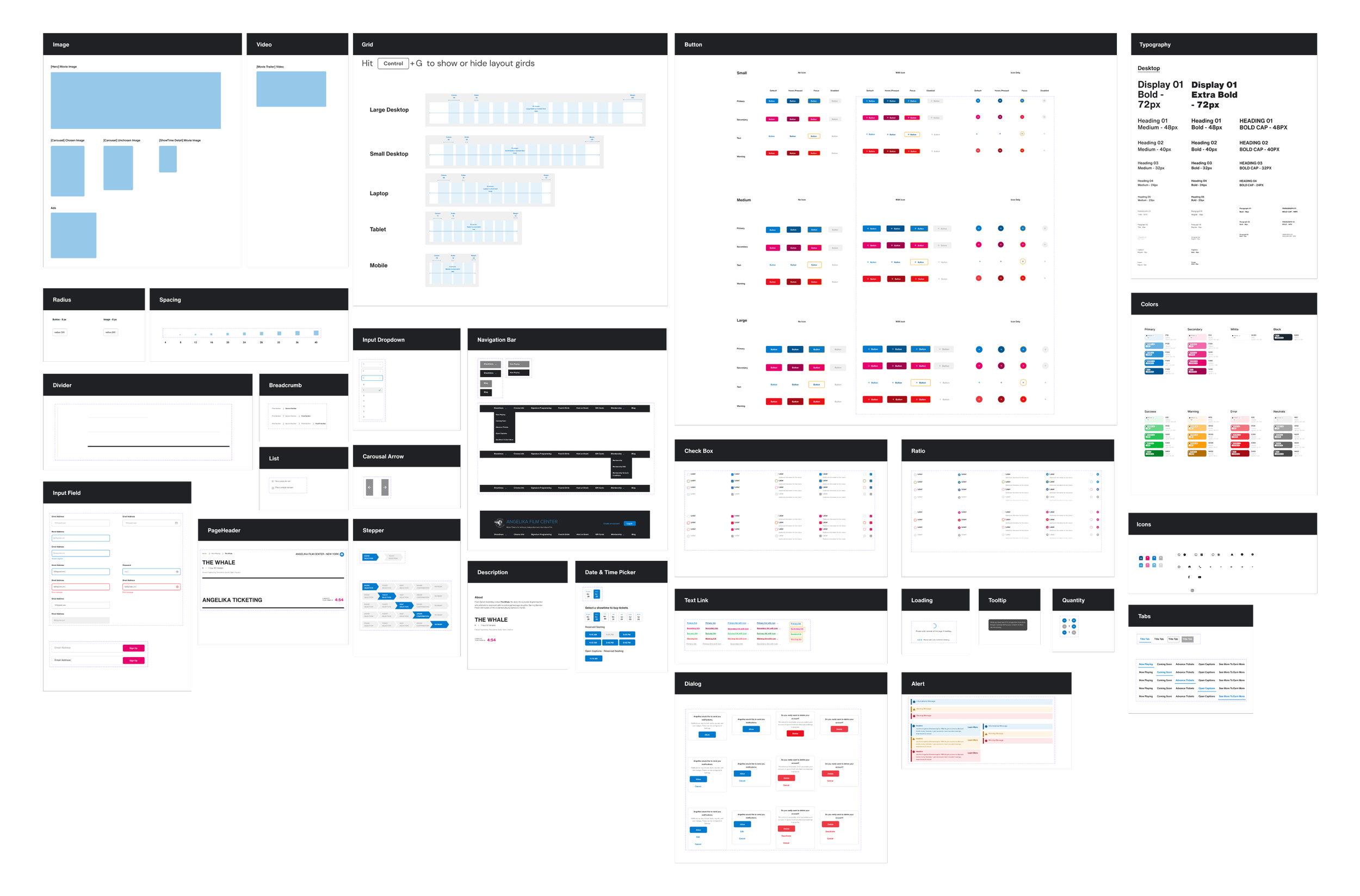
Simula Design System
Crafting an atomic design system to address design inconsistencies and enhance accessibility.
-
![]()
Kazani Beauty
Evaluate and improve the usability issues on a hair beauty website to make users stay on the website and purchase.
-
![]()
Instant Mask Map
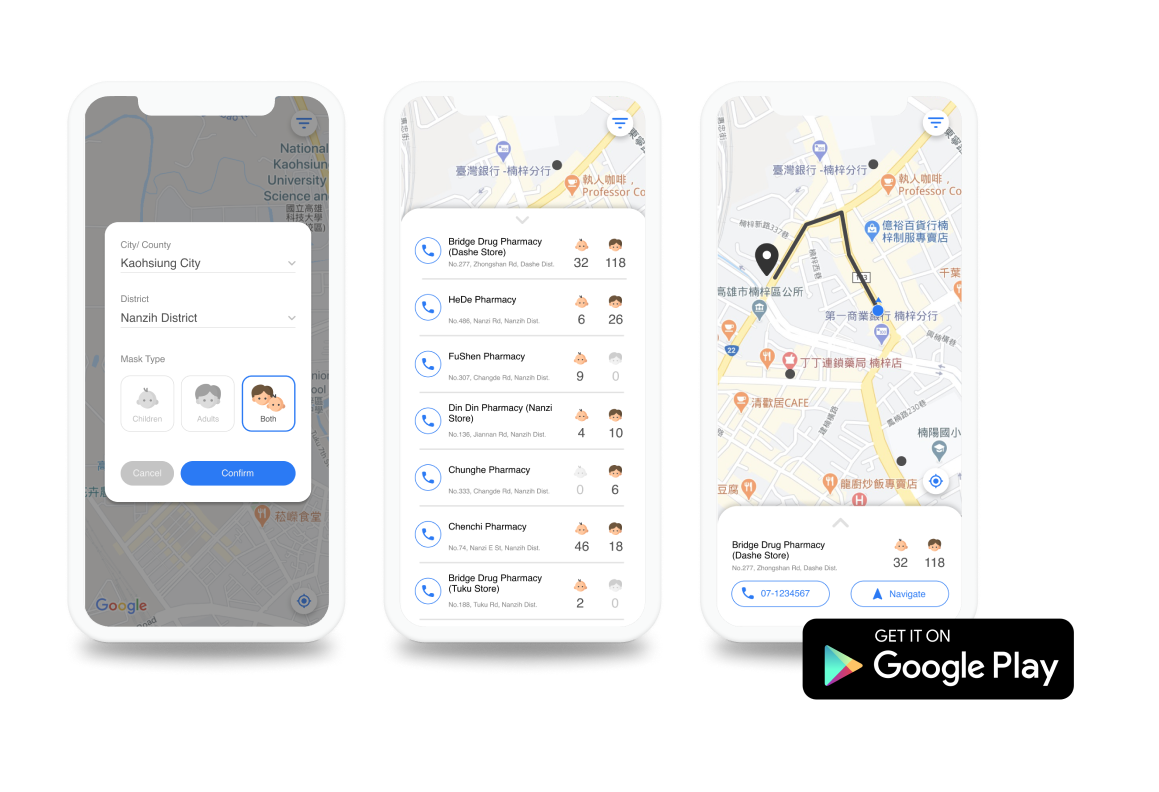
A mobile app that empowers Taiwanese people to improve their efficiency in searching for masks.